
Iceland · Highland Safety Guide · 2026
Winter Highlands
Driving in Iceland
F-roads, Super Jeeps, glacial river crossings and whiteout storms — the definitive safety guide for Iceland's most extreme driving.
The Icelandic Highlands — Hálendið — are the vast, uninhabited interior of Iceland: roughly 40% of the country, a raw plateau of glaciers, lava fields, geothermal valleys and mountain passes crossed only by rough F-roads. In summer it is one of Europe's last great wildernesses. In winter it becomes one of its most serious driving environments.
What makes the Highlands unique is total exposure. There are no towns, no fuel, no mobile coverage and no quick rescue. Weather that would be a nuisance on the coast becomes life-threatening on the plateau, and the only roads in are unpaved mountain tracks that ford glacial rivers.
This guide is for travellers who want to experience the Highlands responsibly — whether self-driving a proper 4×4 in summer or joining a guided Super Jeep expedition in winter. If you are an inexperienced driver, travelling alone, or attempting closed roads in a 2WD car, the Highlands are not for you: every year that decision costs lives and triggers expensive volunteer rescues.
Highlands at a glance
Elevation
400–1,000 m
Road opening season
Late Jun – Sep
4×4 required
Always
River crossings
Frequent
Average winter temp
−10 to −25°C
From Reykjavík
2–4 hrs to edge
Driving time (loop)
Full day+
Road condition
Unpaved F-roads
When to Visit — Season by Season
Summer (Jun–Aug)
+
🛣️ Roads
Most F-roads open late June to July as snow clears and rivers are inspected. Peak access.
🌡️ Weather
Mildest of the year (5–15°C) with near-24-hour daylight, but sudden cold snaps and storms still occur.
⚠️ Safety
The safest window for self-driving, yet river levels peak on warm afternoons — cross in the morning.
🚗 Access
Self-drive in a highland-approved 4×4, guided tours, hiking and camping all possible.
Autumn (Sep–Oct)
+
🛣️ Roads
F-roads begin closing from late September; higher routes go first. Check road.is daily.
🌡️ Weather
Cooling fast with early snow at altitude. Shorter days and the first aurora nights.
⚠️ Safety
Conditions turn quickly — carry winter gear and have a bail-out plan for every route.
🚗 Access
Shoulder-season self-driving still possible on lower routes; guided tours safest.
Winter (Nov–Mar)
+
🛣️ Roads
Nearly all F-roads legally closed. Access is by guided Super Jeep only, on select routes.
🌡️ Weather
Extreme: −10 to −25°C, hurricane-force winds, whiteouts and total darkness for most of the day.
⚠️ Safety
Independent highland driving is effectively impossible and often illegal. Go guided.
🚗 Access
Guided Super Jeep expeditions to Þórsmörk, Kaldidalur and occasionally Kjölur.
Spring (Apr–May)
+
🛣️ Roads
Roads still closed while crews inspect and repair frost-heaved tracks. Openings begin late May.
🌡️ Weather
Deceptive — bright days but heavy snowpack and, later, dangerous glacial-melt river surges.
⚠️ Safety
Spring sees the busiest rescue season as melt makes river crossings unpredictable.
🚗 Access
Guided tours only until roads reopen; superb light for photography.
Weather in the Highlands
The Highlands sit above the marine layer that moderates coastal Iceland, so conditions are colder, drier and far more violent. Weather can flip from calm to a full blizzard in under two hours, and there is zero shelter.
Wind
Gusts of 40–50+ m/s (150–180 km/h) are recorded every winter and can flip a vehicle. Always check wind at vedur.is before setting out.
Snow & whiteout
Blowing snow erases the horizon in minutes. Driving in a whiteout is deadly — you can drive off a slope without seeing it.
Fog
Highland fog forms fast, especially near geothermal areas, dropping visibility below 10 metres.
River crossings & road closures
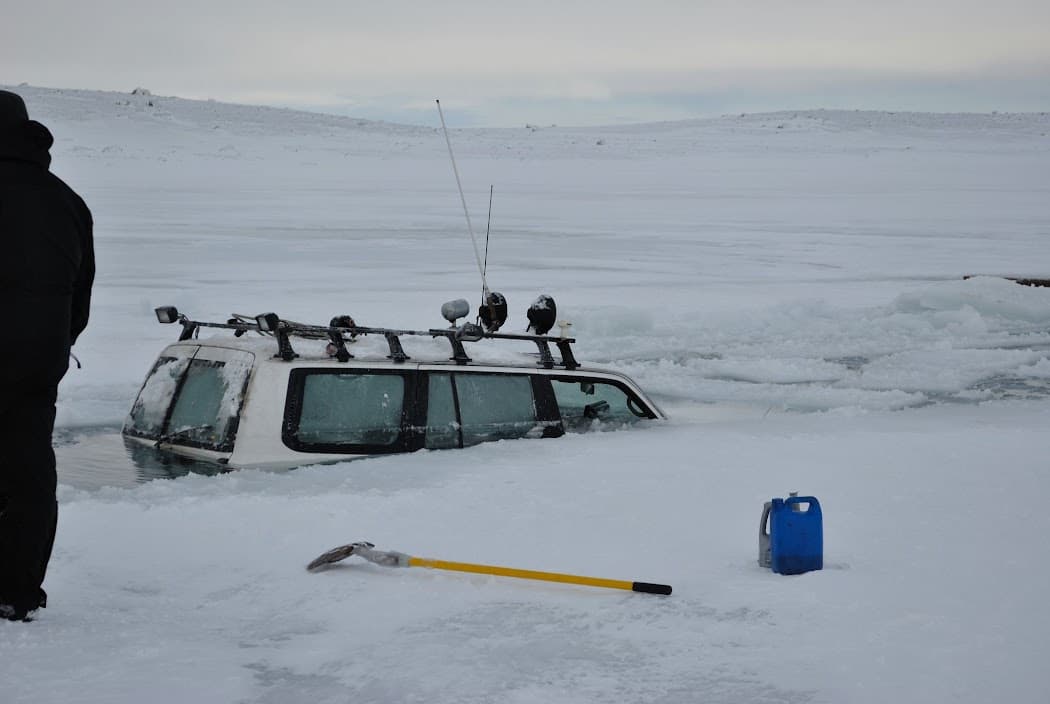
Glacial rivers rise on warm afternoons and freeze unpredictably in winter. Roads close for real hazards — never drive around a closure sign.
Driving Tips
Do
- Check road.is and vedur.is every single morning
- Register your travel plan at safetravel.is before departing
- Keep your fuel tank above half at all times
- Walk every river crossing on foot before driving it
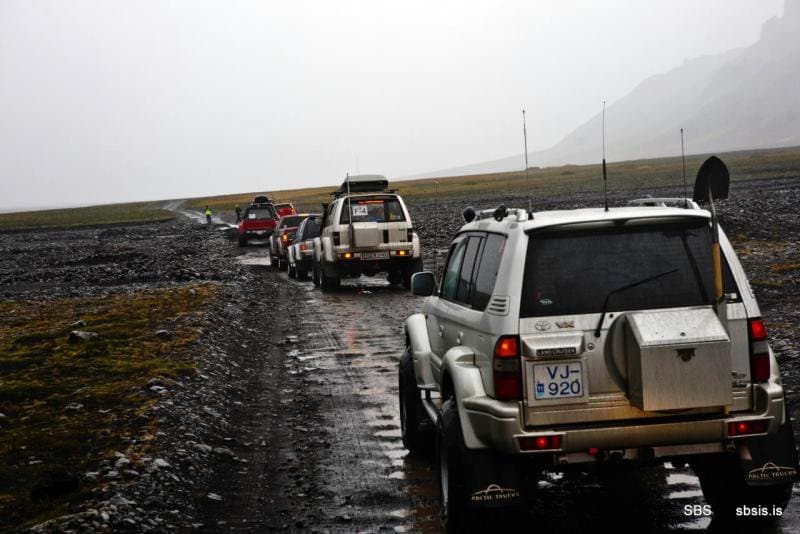
- Travel in a convoy of at least two vehicles
- Carry a satellite communicator and paper maps
Don't
- Never drive a 2WD car on an F-road — it's illegal and voids insurance
- Never drive around or past a road-closure sign
- Never rely on phone GPS alone — coverage is zero
- Never cross a river deeper than your knees with current
- Never drive highland tracks after dark in winter
- Never continue into deteriorating weather — turn back early
Packing Checklist
Tick these off before you leave. In winter, several of these are the difference between an inconvenience and an emergency.
🎒 Packing Checklist
Safety First
Road closures are law
Driving a closed F-road is a criminal offence in Iceland. You face fines, full liability for rescue costs and voided insurance.
River crossings kill
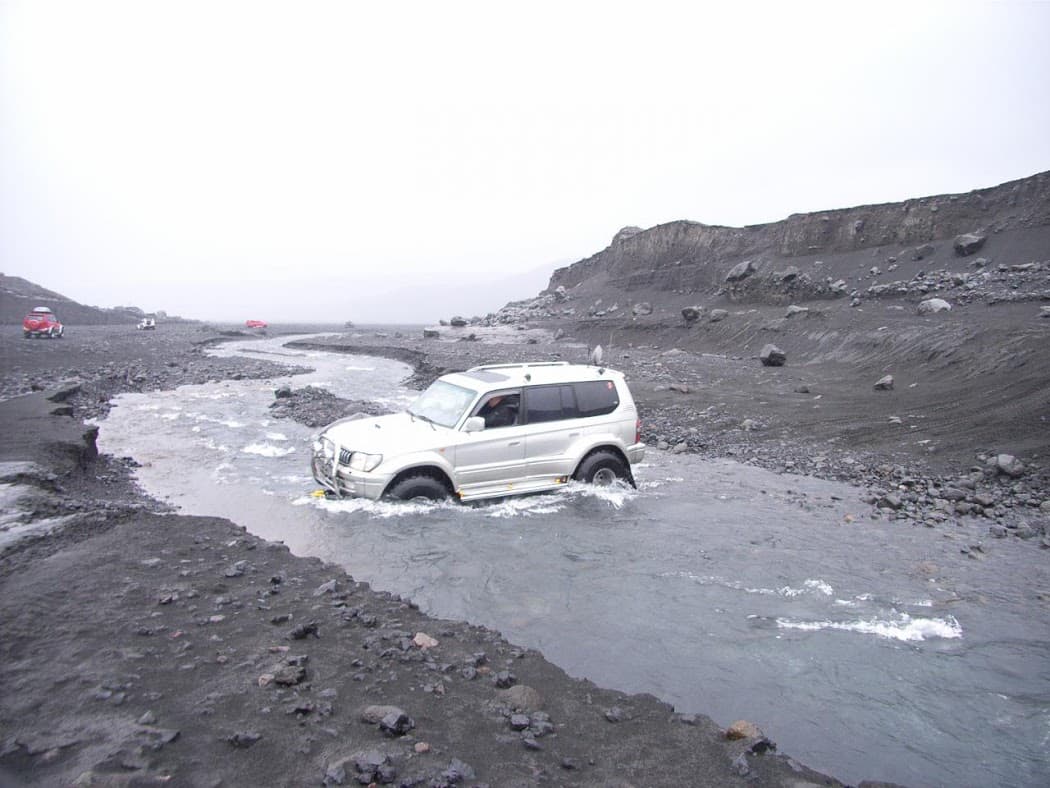
Walk every crossing first, enter at a slight upstream angle, drive slow and steady, and never cross alone.
Weather alerts
Yellow/orange/red warnings on vedur.is are serious. If a red warning is issued for your area, do not travel.
Emergency number 112
112 reaches police, fire, ambulance and ICE-SAR mountain rescue. Stay with your vehicle — it is far easier to find than a person.
Emergency: 112 · Road status: road.is · Weather: vedur.is · Register: safetravel.is
Top Highland Areas

Landmannalaugar
Hard · closed in winterRainbow-coloured rhyolite mountains, obsidian lava fields and a natural hot spring. The jewel of the southern Highlands.

Askja
Very hard · July onlyA remote volcanic caldera in the northern interior with the milky-blue Víti crater lake and vast ash deserts.
Kerlingarfjöll
Moderate · summerA geothermal mountain range of steaming valleys, red ridges and hiking trails beside the Kjölur route.

Þórsmörk
Hard · Super JeepA green valley cradled between three glaciers, laced with rivers — the end of the Laugavegur trek.
Sprengisandur
Very hard · summer onlyThe longest and most desolate highland route, crossing the black gravel desert between Iceland's two great glaciers.
.jpg&w=2048&q=75&dpl=dpl_pfmGjaek3gjJA1o8CPKmxW7HYTtq)
Lakagígar (Laki)
Hard · summer onlyA 25 km row of moss-covered volcanic craters from the catastrophic 1783 eruption — hauntingly beautiful.
Highlands Map
8 highland areas & attractions mapped — filter and tap a pin.
Highlands Gallery
Recommended Tours
Accommodation
Where to Stay
Hotels, guesthouses and apartments in Highlands Gateway
Hotels.com
Best prices · Free cancellation · 10% off with secret prices
Affiliate links — we may earn a commission at no extra cost to you.
Frequently Asked Questions
Can you drive the Icelandic Highlands in winter?
+
Not independently in most cases. Almost all F-roads are legally closed from October to June. Winter access is realistically only via guided Super Jeep tours on select routes.
Do I need a 4×4 for the Highlands?
+
Yes, always. F-roads legally require a high-clearance 4×4, and standard rental cars are prohibited on them regardless of season.
When do the F-roads open?
+
Typically late June to July as snow clears and rivers are inspected. Kjölur (F35) is usually first; F88 to Askja is often last, sometimes late July.
Is it illegal to drive on closed F-roads?
+
Yes. It is a criminal offence, you are fully liable for rescue costs, your insurance is void, and off-road driving damages protected nature.
What is a Super Jeep?
+
A heavily modified 4×4 (Land Cruiser, Defender, Wrangler) with lifted suspension, portal axles and 38–44-inch tyres run at very low pressure, able to cross snow and rivers ordinary 4×4s cannot.
How cold does it get in the Highlands in winter?
+
Frequently −10 to −25°C, and far colder with windchill. Even summer nights can drop below freezing.
Is there mobile phone coverage in the Highlands?
+
Effectively none. There are no cell towers in the interior. Carry a satellite communicator such as a Garmin inReach.
Can I cross glacial rivers in a rental car?
+
Most rental insurance explicitly excludes river-crossing (water) damage even on approved 4×4s. Read your contract — one crossing can cost you the whole vehicle.
What is the difference between a 4×4 and a Super Jeep?
+
A standard 4×4 handles gravel and open F-roads. A Super Jeep is purpose-built for deep snow, big rivers and glaciers, with far greater clearance and flotation.
What tyre pressure should I use in snow?
+
Air down significantly: roughly 12–18 PSI in deep snow for a standard 4×4, and always reinflate before returning to paved roads.
Are guided Super Jeep tours worth it?
+
In winter, yes — they are the only responsible way in for most visitors, and local guides add safety plus knowledge no guidebook can match.
Can you visit Landmannalaugar in winter?
+
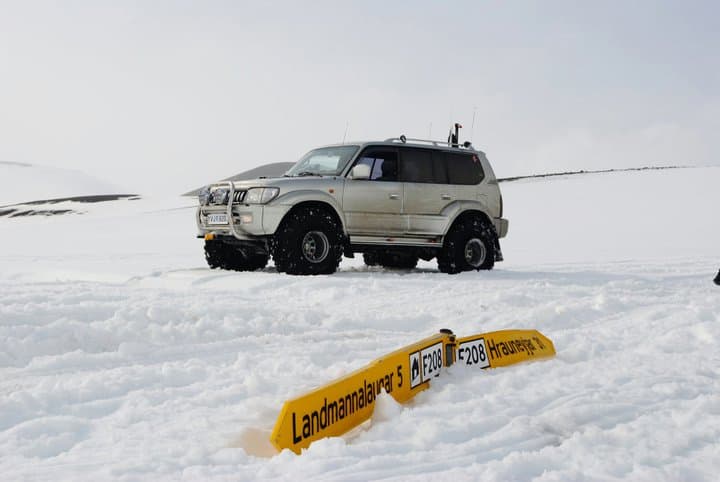
Only on a specialist guided Super Jeep trip in good conditions. F208 is legally closed from late October and there is no independent access.
What should I do if I get stuck?
+
Stay with your vehicle, call 112, and use your satellite communicator if there's no signal. A vehicle is far easier to spot from the air than a person on foot.
Do I need to register my travel plan?
+
Yes — submit it free at safetravel.is before departing. ICE-SAR uses it to locate you if you fail to return.
How much extra fuel should I carry?
+
At least 20 litres. There are no fuel stations in the interior and distances between stations can exceed 200 km.
What is the most accessible highland route?
+
Kjölur (F35) in summer is the easiest major route with no large river crossings. Kaldidalur (F550) is the most likely to be briefly accessible in mild winters.
Can you camp in the Highlands?
+
Yes, in summer, at designated huts and campsites (Landmannalaugar, Þórsmörk, Kerlingarfjöll). Book huts far in advance; wild camping is restricted.
Are the Highlands good for Northern Lights?
+
Excellent — near-zero light pollution makes for outstanding aurora, but only visit in winter with a guide given the driving hazards.
What is Sprengisandur?
+
The long central desert route (F26) between Hofsjökull and Vatnajökull — Iceland's most remote highland traverse, summer only.
How long does it take to cross the Highlands?
+
Plan a full day or more for any traverse. Distances are long, speeds are slow (30–50 km/h on rough tracks), and you should never rush.
Is Kjölur or Sprengisandur harder?
+
Sprengisandur is longer, rougher and more remote. Kjölur is graded and river-free, making it the gentler of the two major traverses.
What emergency number do I call in Iceland?
+
112 for everything — police, ambulance, fire and ICE-SAR mountain rescue. It works on any network with partial signal.
Can I drive the Highlands alone?
+
It is strongly discouraged. Travel in a convoy of at least two vehicles; a single breakdown or getting stuck can become life-threatening alone.
Do I need snow chains?
+
Carry at least one set in winter conditions — they are effectively compulsory on mountain roads and can free a stuck vehicle.
What is the best time overall to visit the Highlands?
+
Mid-July to mid-August for self-driving: maximum road access, mildest weather and long daylight. Choose a guided tour for the winter experience.
Plan your Highlands adventure
Everything you need to explore Iceland's interior safely — routes, tours, hotels and live tools.
🌌 See the Northern Lights
Track real-time aurora activity and plan your Northern Lights trip with AuroraVision.
Tours & Experiences
Book Activities in Iceland
Tours & Activities
Book top-rated Iceland tours, day trips, and experiences — Northern Lights, glacier hikes, whale watching and more.
Browse Activities →Reykjavík City Pass
Unlimited access to top Reykjavík attractions, museums, and tours with one pass. Save up to 50% vs paying separately.
Get City Pass →


